


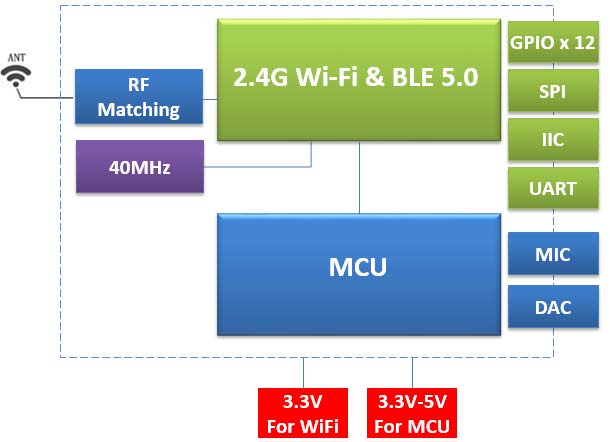
A voice-enabled product needs a clear division between local interaction and network-dependent services. The DOIT AI-01 manual describes a module that combines Wi-Fi and Bluetooth connectivity with a dedicated audio MCU. Its documented application areas include voice toys, storytelling devices, smart-home products and robots.
Two processing roles in one module
| Function | Specification stated in the manual |
|---|---|
| Wireless processor | ESP8684H4 / ESP32-C2 platform |
| Audio MCU | 32-bit RISC-V core, 240 MHz, with FPU support |
| Wireless connectivity | 2.4 GHz Wi-Fi 802.11 b/g/n and Bluetooth LE |
| Module dimensions | 18 × 25.5 × 3 mm |
| Flash listed | 32 Mbit, equivalent to 4 MB |
| Antenna | PCB |
| Local voice capability | Up to 50 offline voice commands described |
The manual separates a wireless processor from the audio MCU. This is useful when planning the product architecture: network connection, command recognition, audio capture and playback should each have a defined role. The module’s support for connected AI interaction does not establish that a large language model runs entirely in its local memory.
Design the offline experience explicitly
The introduction describes recognition of up to fifty offline voice commands, and the appendix provides command examples. Review the supplied command set and supported language before defining the product’s voice interface. Do not assume arbitrary phrases or additional languages are available without firmware work and validation.
Decide which functions should remain available when the network is disconnected. A local command can be designed to control a device function, while an online conversation may require connectivity and a separate service. Give the user a clear indication of listening, processing, playback and connection failure states.
Integrate the audio path
The feature list includes noise suppression, a single-channel 16-bit ADC and a two-channel 16-bit DAC, together with support for several audio decoding formats. The available format list alone does not define recording quality or acoustic performance. Microphone selection, gain, speaker design and the enclosure all influence the result.
Evaluate recognition in the intended environment, including background noise, speaker playback and expected user distance. Measure the complete interaction time from speech to response. These tests reveal whether the hardware and firmware behavior suit a toy, appliance or another product category.
Keep power domains and signal levels clear
The manual lists different supply ranges for the two processor sections: 3.0–3.6 V for the Wi-Fi MCU and 3.0–5.0 V for the audio MCU. Follow the actual pin definitions and application schematic when connecting them. A voltage supported by one section should not be applied indiscriminately to another section or to its I/O.
The interface list includes UART, I²C, SPI, PWM, ADC/DAC and microphone-related connections. Create a pin allocation that includes programming and diagnostics, then validate startup, network connection and audio playback under the maximum expected load.
For an AI-01 product brief, document the local command set, online service dependencies, audio hardware and behavior without a network. That gives engineering and product teams a concrete integration target without confusing advertised AI connectivity with an already completed application.
Source: Supplied DOIT user manuals for the models discussed.
Leave a Reply
You must be logged in to post a comment.