


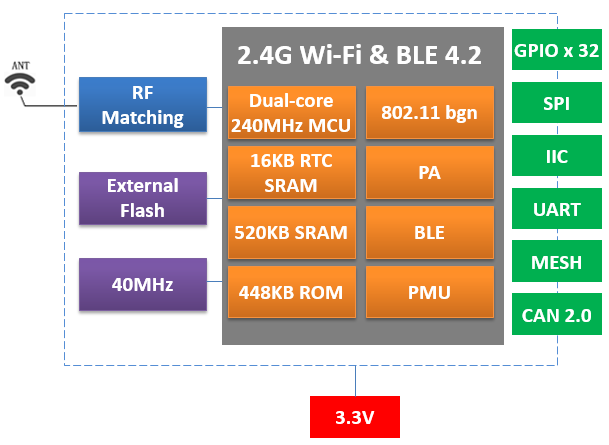
DOIT’s original ESP32 module family combines a dual-core processor with 2.4 GHz Wi-Fi and Bluetooth connectivity. The ESP32-32S, ESP32-32D, ESP32-32E, ESP32-32SE and ESP32-32UE share a broad platform, but their antenna arrangements and documented chip variants differ. Those distinctions matter when selecting a new module or assessing a hardware revision.
Compare the documented configurations
| Module | Chip listed in the manual | Antenna | Module dimensions |
|---|---|---|---|
| ESP32-32D | ESP32-D0WD | PCB | 18 × 25.5 × 3 mm |
| ESP32-32S | ESP32-D0WD-V3 | PCB | 18 × 25.5 × 3 mm |
| ESP32-32E | ESP32-D0WD-V3 | PCB | 18 × 25.5 × 3 mm |
| ESP32-32SE | ESP32-D0WD-V3 | U.FL / IPEX | 18 × 25.5 × 3 mm |
| ESP32-32UE | ESP32-D0WD-V3 | U.FL | 18 × 19.2 × 3 mm |
The manuals specify a dual-core 240 MHz processor, 520 KB SRAM and 16 KB RTC SRAM, with 4 MB flash as the default configuration. The ESP32-32E and ESP32-32UE ordering tables also identify N4, N8 and N16 options, corresponding to 4, 8 and 16 MB of flash. Select an explicit memory variant when ordering rather than relying on the base model name.
Separate firmware storage from working memory
Flash capacity determines how much nonvolatile space is available for firmware and stored data. SRAM supports the running application. Choosing a larger flash variant does not increase the processor’s internal SRAM. When planning updates, include the bootloader, partition table, application images and persistent settings in the storage budget.
The listed peripheral functions include I²C, I²S, SPI, ADC, PWM and TWAI. Build a pin allocation before committing the schematic: exposed pins can have startup requirements, input-only restrictions or shared functions. A headline GPIO count is a starting point for review, not a count of unrestricted output pins.
Choose the antenna around the enclosure
The PCB-antenna versions simplify the antenna assembly when the host board can leave the antenna area unobstructed. Place the module using the layout guidance in its manual and evaluate nearby metal, wiring and the enclosure. An otherwise suitable radio module can perform poorly if its antenna is boxed in by conductive parts.
ESP32-32SE and ESP32-32UE provide an external antenna connection. This gives more freedom to locate the radiator, while adding an antenna, cable and connector to the assembly. ESP32-32UE also has a shorter stated module body. Verify the full mechanical drawing and connection details; an antenna suffix is not proof of a drop-in replacement.
Verify power and the exact hardware revision
The manuals specify a 3.0–3.6 V supply range with 3.3 V as the typical value. Evaluate startup and radio activity on the real board, and follow the selected module’s reset and download-mode wiring. For a redesign, retain a record of the chip revision, flash option and antenna assembly used in the tested sample.
These modules are documented for Wi-Fi 802.11 b/g/n and Bluetooth 4.2 connectivity. Projects that require a different radio generation should compare the relevant C-series or S3 documentation explicitly. Within this original ESP32 family, the most useful selection questions are the required peripheral mapping, firmware storage budget and antenna location.
Source: Supplied DOIT user manuals for the models discussed.
Leave a Reply
You must be logged in to post a comment.