


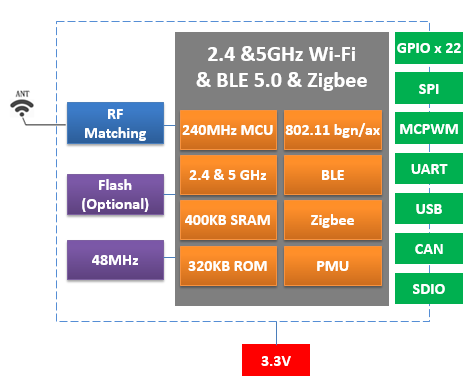
The DOIT ESPC5 family is documented for both 2.4 GHz and 5 GHz Wi-Fi, alongside Bluetooth LE and IEEE 802.15.4. Its manuals describe a 240 MHz single-core RISC-V processor, 384 KB high-performance SRAM and 16 KB low-power SRAM. For product designers, the next choices are the physical format, antenna connection and memory configuration.
Three formats, each with an antenna alternative
| Module pair | PCB-antenna model | External-antenna model | Feature-list GPIO count |
|---|---|---|---|
| ESPC5-12 / 12E | 16 × 24 × 3 mm | 16 × 24 × 3 mm | 19 |
| ESPC5-20 / 20E | 18 × 20 × 3 mm | 18 × 20 × 3 mm | 15 |
| ESPC5-32 / 32E | 18 × 25.5 × 3 mm | 18 × 19.2 × 3 mm | 22 |
The E versions use an external U.FL antenna connection in their ordering tables. For a dual-band product, specify an antenna and cable assembly suitable for both operating bands. Reserve the complete antenna space in the enclosure and check wireless behavior with the final mechanical assembly.
Choose flash and PSRAM independently
| Ordering suffix | Flash | PSRAM | Listed module formats |
|---|---|---|---|
| H4 | 4 MB | None listed | 12, 12E, 20, 20E, 32, 32E |
| N8R8 | 8 MB | 8 MB | 32 and 32E |
| N16R8 | 16 MB | 8 MB | 32 and 32E |
These capacities are converted from the ordering tables’ Mbit values. Flash holds persistent program and data storage; PSRAM provides additional volatile memory for an application configured to use it. A design that needs both larger firmware storage and larger runtime buffers should specify both capacities in its part selection.
Understand the role of each wireless capability
The manuals list Wi-Fi 6 support, Bluetooth LE and an IEEE 802.15.4 radio with Thread 1.3 and Zigbee 3.0 named in the protocol features. These capabilities support different product architectures. A Wi-Fi-connected device, a Bluetooth commissioning flow and a Thread or Zigbee application each need suitable firmware and integration work.
Do not interpret a list of supported protocols as a guarantee of simultaneous full-rate operation, a ready-made gateway or a finished interoperability certification. Define which radios are active during setup and normal operation, then evaluate coexistence under the actual traffic pattern.
The manuals state Wi-Fi PHY rates up to 150 Mbps and specify bandwidth restrictions by mode. The peak link figure is not a promise of sustained application throughput on every band or protocol. Benchmark the product using the routers, payload sizes and connection conditions it will encounter.
Finish the hardware review with the exact variant
Check pin allocation for the selected package, including UART access, reset, startup configuration and shared peripheral functions. The 12, 20 and 32 formats expose different interface counts, so a move between them requires a schematic review even when the firmware platform remains related.
The manuals’ temperature entries are not fully consistent across sections and variants. Obtain a confirmed operating range for the exact orderable part before specifying an environmental rating. Also validate the 3.3 V supply during RF startup and transmission. The final selection should identify the module suffix, memory configuration, antenna assembly and approved hardware revision together.
Source: Supplied DOIT user manuals for the models discussed.
Leave a Reply
You must be logged in to post a comment.